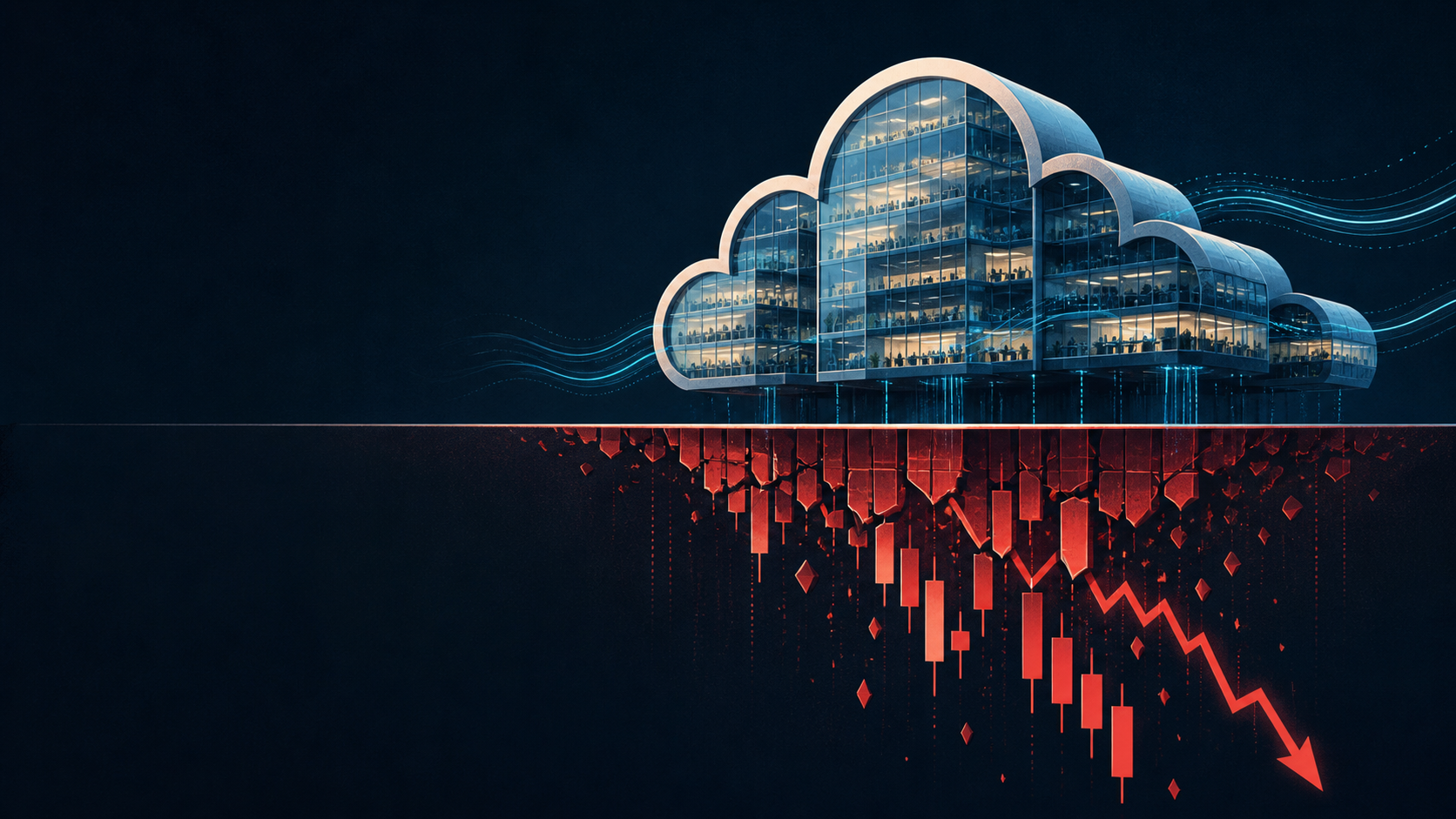
If you look at the stock market, it looks like a big collapse has happened. If you look at the income statements, it does not look like anything happened. So what is happening?
Between mid-January and mid-February 2026, roughly $2 trillion of software market value disappeared.
The damage was not limited to weak companies. Salesforce was worth about $238 billion in the middle of 2025. By July 2026 it was worth about $134 billion. Nearly half the company gone, in about a year.
If an apocalypse means companies becoming worth far less, it happened.
Over the past year, investors changed their minds about what a dollar of software revenue is worth. The software sector’s forward price-to-earnings multiple fell from about 84 times earnings at the 2021 peak to about 23 times by March 2026. For the first time on record, software traded at a lower multiple than the S&P 500 as a whole. The median SaaS revenue multiple fell from 6.7 times in Q1 2025 to 3.6 times in Q1 2026 — a 46% collapse in one year.
But did the businesses collapse? No.
Take Adobe. In the same stretch its stock fell more than 40% from its high. Yet in its second quarter of 2026 Adobe reported record revenue of $6.62 billion, up 13% from a year earlier, and its AI product revenue tripled past $500 million.
The wider picture was the same. Across public SaaS, median profit margins reached an all-time high. Mergers and acquisitions hit a record, with about 2,700 SaaS deals in 2025, up 28% from the year before.
The companies did not lose their customers. They lost their story.
For twenty years the SaaS story was almost perfect. Revenue was recurring. Margins were high. Customers rarely left. Once a product was inside a company it was hard to remove. More employees meant more seats, more seats meant more revenue, and each new dollar of revenue cost almost nothing to deliver.
So investors were not only paying for this year’s profit. They were paying for the belief that the machine would keep running for decades. AI broke the belief when it arrived as a real product in early 2026, when Anthropic released Claude Cowork and plugins that can replace SaaS products.
Then came four separate worries, each aimed at a different part of the model.
Most SaaS is sold by the seat. But what happens when ten people become three people working with seven agents? The work still gets done. The ten licences do not. For years SaaS quietly rode headcount growth. AI can run that in reverse. The customer gets more done, and the vendor gets paid less.
Many software products are a handful of features wrapped in a workflow. AI turns some of those features into a single prompt. Summarizing text used to be a product. Now it is a prompt. Pulling data out of a document used to be a product. Now it is a prompt. This does not mean every application dies. It means investors can no longer assume that every feature deserves its own company.
The most valuable spot in software is usually not the database. It is the interface where the work happens. Agents threaten that spot. Tomorrow a user may not open Salesforce or Jira. They may tell an agent what they want done. The old application still holds the data underneath, and its APIs still run thousands of times a day. But the customer now talks to the agent. The interface stops being where the value sits. The product becomes invisible, and invisible things are worth less.
SaaS grew huge because buying was cheaper, faster and safer than building. AI lowers the cost of building. A company that once bought a narrow tool can now ask a small team to assemble something passable from models and APIs. “Good enough” is a dangerous phrase for a subscription business. The internal version does not have to beat the product. It only has to be good enough, and cheaper.
AI was definitely the trigger, but probably not the entire cause. SaaS walked into 2026 already weak. Pandemic-era prices were too high. Higher interest rates had made far-off growth less valuable. Software budgets were crowded with overlapping tools. Growth was slowing as the market matured. The repricing had started before any agent shipped.
What AI added was a reason to believe the repricing was permanent. That is the key difference. A normal slowdown lowers next year’s revenue. AI threatens terminal value, the worth of all the years after next year. It raises questions no one can answer yet. How many seats will a customer need? Which features stay defensible? Who owns the interface? Will customers keep buying, or start building?
Markets do not wait for answers. They price the odds that the answers are bad.
Mission-critical systems still matter. Proprietary data still matters. Security, regulation, integrations, and deeply embedded workflows do not vanish because a model can produce a good demo. The record deal volume shows buyers still paying real money for the right software. Some companies will use AI to become more valuable. Others will learn that what they called a product was a feature waiting to be absorbed. That sorting has only begun.
In valuations, absolutely. In operating performance, not yet.
AI did not have to kill SaaS. It only had to make investors believe SaaS would be worth less. And that was enough to erase trillions.